
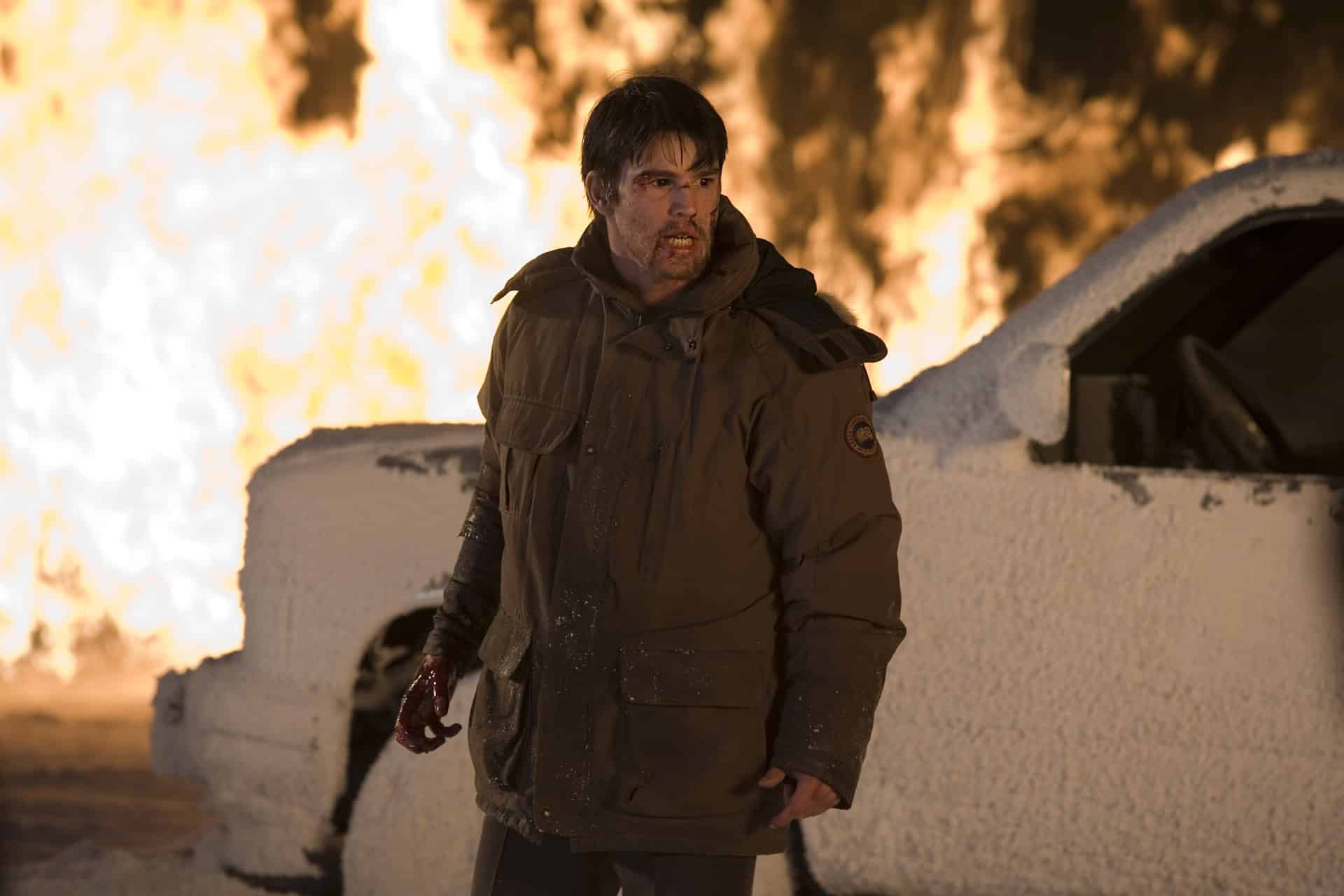
The northernmost town in Alaska, where the sun’s just setting for the last time in 30 days, is the perfect place for vampires to rock up.
That’s the high concept behind the 3-issue comic book miniseries 30 Days of Night, written by Steve Niles, illustrated by Ben Templesmith, and published by IDW Publishing in the early 2000s.
It’s a high-concept that transfers excellently to film—unsurprisingly given Niles had first touted the idea as a film before the comic—inspiring director David Slade, who actively pursued this as the subject for his second feature, to give us one of the more distinctive, blood-splattered and gratuitous horrors of the 2000s.
30 Days of Night Summary
The narrative is pretty straightforward from an opening that’s tinged with Frankenstein and sees a stranger (Ben Foster, in a quite extraordinary performance) walking into a town that’s shutting down. The pretty long buildup has the townsfolk splitting up—those who can’t take the dark fleeing and leaving a few loved ones, partners and more to face a month-long night. With the town locked down and the vampires moved in, can anyone make it through the 30 days to tell the tale?

Here for the Red SNOW
It’s a slow, rugged, and serious build-up that even introduces Chekhov’s metal grinder and Chekhov’s cannabis farm. But the steady warm-up pays off as soon as the first human kill, 20 minutes in, serves up a distinct brand of feral vampires. One incredible aerial shot unfolds the devastation of the vampires taking out the hapless, unprepared townsfolk, with blood spilling liberally across the snow. It’s a bloody great look.
Slade took pains to build the vampire culture. He may have had the art and words of the comic to draw on, but he had to create the sound, and the result is extraordinary. Led by Danny Huston’s Marlow—all stuttering, spluttering stretched rasps at the start of the actor’s significant stride into movie villainy—the vampires speak in a subtitled language much of the time—a commitment that really sells the idea of the other: a species ancient and hidden who cannot afford to leave any witnesses behind.
The idea was to give the vamps every bit of the background that the dwindling group of human survivors under siege enjoy. At the heart of it is Josh Hartnett’s Sheriff Eben and his estranged wife Stella (Melissa George), forced back together not just to survive but to lead as the days pass. It’s a ragtag set of survivors with some typical archetypes. A highlight is Mark Boone Junior as Beau (“Just because something stopped Bela Lugosi doesn’t mean it can stop those things”). His suicide mission to take out as many vamps as possible with a tractor, chain trencher, and dynamite is a blast, and showcases the pretty solid, consistent VFX.
30 Days of Night brutally pounds along, serving up scary, tense and grizzly scenes, all captured by Slade’s superb direction and Jo Willems’ stunning cinematography. You can’t go wrong with blood splattered over snow, and with Icon’s impressive 4K restoration upping the picture along with the sound (Dolby Atmos no less), the best the film has ever looked or sounded reveals just how well put together it was nearly two decades ago.
Now released in a startling new steelbook set, fans and newbies won’t be disappointed with the eight making-of documentaries, new interviews with Slade, composer Brian Reitzell, actor Mark Rendall and comic book originator Steve Niles, as well as new commentaries. Bloody good stuff.
30 Days of Night arrives on Steelbook 4K UHD on 27 July.
0 Comments